
If you’re tired of repeating yourself…
If you’re rewriting the same proposal with minor variations…
If every “quick question” turns into a 20-minute explanation…
You don’t have a productivity problem.
You have a knowledge distribution problem.
A digital twin isn’t a flashy AI persona. It’s a structured extension of how you think — your frameworks, your tradeoffs, your thresholds, your decision logic — so you’re no longer the only container of your reasoning.
When your thinking is structured, something changes.
You stop starting from zero.
You refine instead of draft.
You validate instead of re-explain.
Here’s the simple version.
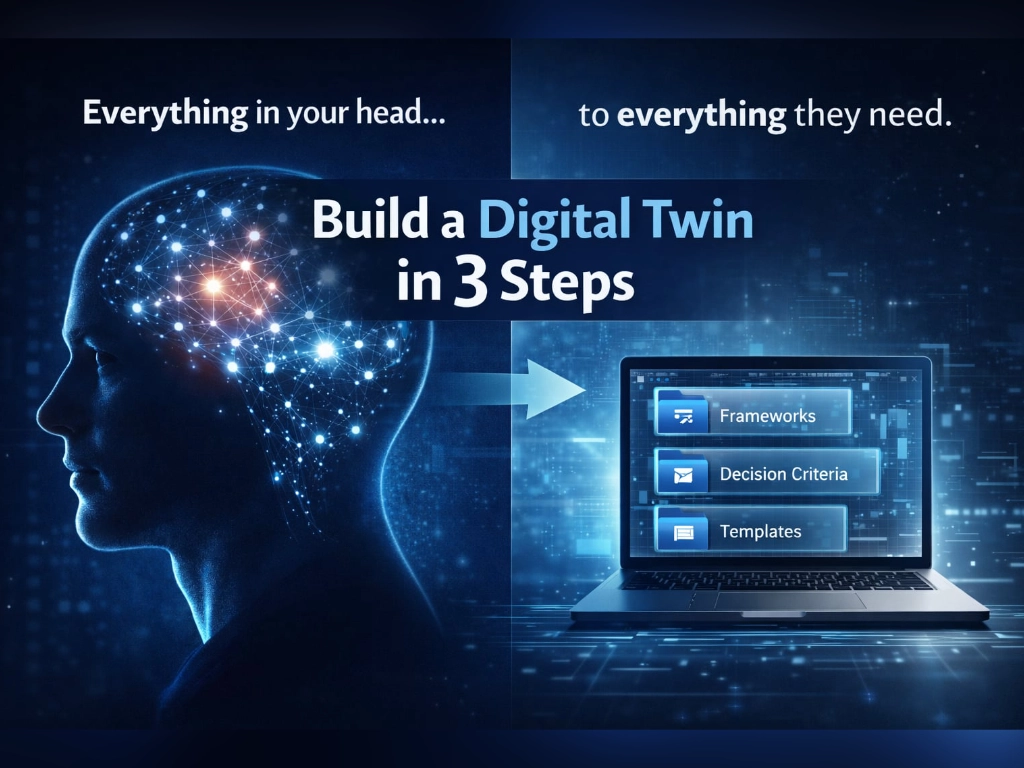
Step 1: Extract Your Thinking
Collect the places where you explain things clearly — proposals, decks, workshop notes, long-form emails. Look for patterns in how you make decisions. Patterns matter more than polish.
Step 2: Architect the Logic
Organize what you find into principles, criteria, tradeoffs, and boundaries. Most overload comes from invisible frameworks living only in your head. Once visible, they become reusable.
Step 3: Build a Working Model
Start simple. A well-designed Custom GPT with strong instructions is often enough. Let it draft in your voice, pressure-test ideas against your criteria, and explain your frameworks consistently. You refine — you don’t reinvent.
The relief isn’t automation.
It’s cognitive offloading.
When your thinking lives outside your head, decision fatigue drops. Delegation speeds up.
Meetings get shorter. You stop being the bottleneck.
And here’s the quiet bonus:
Building the twin sharpens you. You see your gaps. You clarify your principles. The clarity alone reduces workload.
If you’re exhausted from repeating yourself, this might be the most practical AI project you build this year.